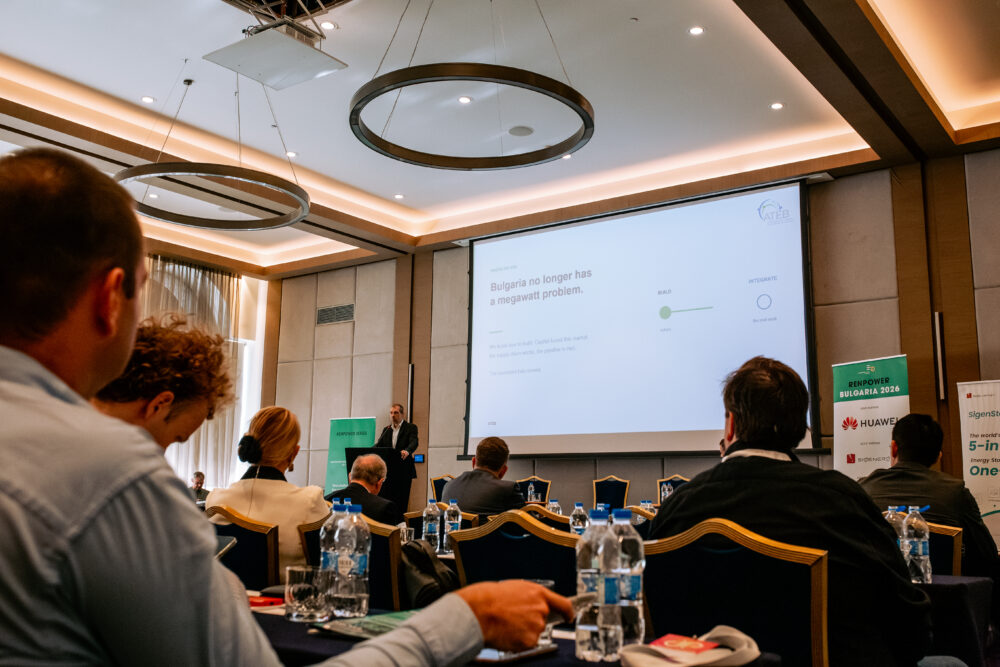
On 17 September 2026, the second edition of RENPOWER Bulgaria took place in Sofia. The forum is dedicated to building the new generation of renewable capacity and storage systems in the country. In the opening session, the Association of Traders with Energy in Bulgaria (ATEB) was represented by Deputy Chair of the Management Board Atanas Dimov.
The session, titled “Bulgaria’s Next Growth Phase: Scaling Utility-Scale Solar & Storage in a Changing Market”, brought together on one stage the system operator, analysts, storage technology manufacturers, the wind sector and traders. The moderator was Miroslav Dzhunev, Senior Manager at EY Bulgaria. Alongside ATEB, the panel included representatives of NEK, Aurora Energy Research, KK Group, PPC Bulgaria and Elektrohold Trade.
The starting point of the ATEB Deputy Chair’s remarks was that Bulgaria no longer has a problem building capacity. According to him, the question that will define the next five years is what happens to the built capacity in real time, that is, how it is forecast, managed and ultimately monetised. It is precisely in the layer between the asset and the market, he noted, that value is created or lost, and as the share of renewables grows, the importance of this layer increases.
From this follows ATEB’s position on storage. According to the Association, a battery without clean access to the balancing market is an asset with half a business model. The obstacle to investment is neither technology nor capital, but revenue certainty, because an investor cannot size a revenue that the regulator has not yet defined. Therefore, the pace of regulation determines the pace of investment.
Atanas Dimov also drew attention to a change that the market has not yet fully absorbed. Since 1 October 2025, European electricity markets, including the Bulgarian one, have traded and settled in fifteen-minute intervals instead of hourly ones. A forecast error that was previously diluted within an hour is now exposed four times over. The requirements for data, forecasting and operational discipline rose for all participants in a single day, and the gap between those who build this capability and those who do not is paid for through imbalance costs.
On behalf of the ATEB Management Board, Atanas Dimov set out three demands:
Non-discriminatory access for storage and industrial consumers to the balancing market, with products that match their characteristics, transparent settlement and no double charging. As an example, the ATEB Deputy Chair pointed to the excise duty that can be charged twice on stored energy, once when the battery is charged and a second time when the same energy is consumed. In his words, this taxes not consumption but flexibility.
Predictable changes to the regulatory framework with the participation of the industry. The rules on storage, demand response, data exchange and supplier switching are being written right now. Written together with the industry, they work from the first time.
Fair price signals, undistorted by market intervention. According to the position presented, flexibility appears only where it is paid for, and any intervention that flattens the signal removes the rationale for the investment.
ATEB declared its readiness to take part in drafting these rules together with the regulator and the system operator, as well as with investors in the sector. Atanas Dimov stressed that, although technology continues to change, the market moves forward through coordination and trust.